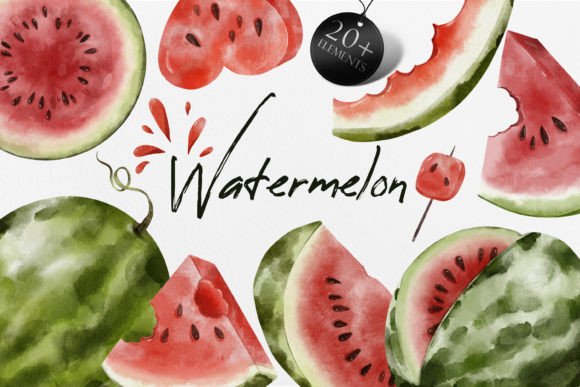
Bringing Summer to Life with Watermelon Watercolor Illustrations
In the realm of digital design, there is a persistent tension between the crisp precision of vector graphics and the organic warmth of traditional media. While vectors offer scalability and clean lines, they often lack the soulful imperfection that draws the human eye. This is where Watermelon Watercolor Illustrations step in to bridge the gap. These hand-painted elements capture the essence of summer, freshness, and vitality in a way that synthetic brushes simply cannot replicate. By integrating these vibrant assets into your workflow, you unlock a level of texture and emotional resonance that elevates any creative project from functional to memorable.
The Artistic Appeal of Hand-Painted Textures
The primary allure of this specific set lies in its origin: every element is meticulously hand-painted. In an era dominated by AI generation and stock photography, the human touch remains a premium asset. When you examine high-quality watermelon clipart, you notice the subtle variations in pigment density, the soft bleed of colors into one another, and the unique paper grain that gives depth to the image. These characteristics are not bugs; they are features that communicate authenticity.
For designers, the challenge is often finding assets that feel curated rather than mass-produced. A standard clip art library might offer a flat, two-dimensional slice of fruit. In contrast, a professional set of watermelon watercolor illustrations offers a dynamic range of tones. The deep reds of the flesh, the gradient transition through the rind, and the speckled black seeds all contribute to a visual narrative of ripeness and flavor. This attention to detail ensures that when these images are placed on a wedding invitation or a cosmetic label, they do not look like generic placeholders but rather like bespoke artwork commissioned for the brand.
Why Transparency Matters in Modern Workflows
One of the most critical technical specifications for modern graphic design is the file format. The inclusion of transparent PNG files at 300 DPI is a game-changer for versatility. High resolution ensures that the delicate brushstrokes remain sharp even when printed on large formats, such as banners or fabric rolls. More importantly, the transparency allows for seamless integration into complex layouts.
Consider a scenario where a designer is creating a packaging mockup for a new line of summer beverages. They need a watermelon slice that appears to be floating behind glass or resting on a textured background. With a transparent PNG, the artist can layer the illustration over photographs, gradients, or other textures without worrying about unsightly white boxes or square borders. This flexibility is essential for creating sophisticated compositions where multiple elements must interact naturally. The ability to combine these isolated elements with each other means you can build entirely new scenes—stacking slices, scattering seeds, or creating repeating patterns—without ever needing to open a painting program.
Transforming Brand Identity with Vibrant Colors
Color psychology plays a pivotal role in branding, and few colors evoke a stronger sense of joy and energy than the bright pink-red of a ripe watermelon. Incorporating Watermelon Watercolor Illustrations into a brand book or logo design can instantly signal freshness, health, and approachability. For businesses in the food and beverage industry, cosmetics, or wellness sectors, these visuals act as a non-verbal cue to the consumer, promising natural ingredients and a refreshing experience.
However, the application extends far beyond product packaging. In the world of corporate identity, these elements can soften the edges of a tech company's communication or add a playful twist to a financial firm's annual report cover. The key is in the balance. Because the illustrations are hand-painted, they possess a certain whimsy that contrasts beautifully with rigid, geometric typography. This juxtaposition creates a visual rhythm that keeps the viewer engaged. Whether used as a subtle watermark on stationery or as the central hero image on a website landing page, the vivid colors help cut through the noise of the digital landscape.
Strategic Applications Across Industries
The versatility of this twenty-one-element set makes it suitable for a wide array of industries. Let us explore how different professionals can leverage these assets to achieve their specific goals:
- Wedding and Event Planning: Summer weddings often seek themes that reflect the season's abundance. These illustrations are perfect for invitations, menu cards, and table numbers. The soft, romantic quality of watercolor pairs exceptionally well with elegant calligraphy, creating an atmosphere of celebration and warmth.
- Textile and Fabric Design: Designers working in fashion or home decor can utilize these isolated elements to create seamless patterns. By repeating the slices and leaves across a canvas, one can generate unique prints for t-shirts, scarves, curtains, or wallpaper. The organic nature of the paint strokes prevents the pattern from looking repetitive or robotic.
- Ceramics and Product Decoration: For artisans creating mugs, plates, or tiles, high-resolution watercolor files allow for precise transfer onto physical goods. The texture of the watercolor mimics the glaze of ceramics, resulting in a cohesive aesthetic that feels handmade.
- Social Media and Web Design: In the fast-paced environment of social media, content needs to stop the scroll. Bright, colorful graphics featuring watermelon motifs are highly shareable and effective for summer campaigns. They work well as Instagram story backgrounds, blog post headers, or email newsletter accents.
- Scrapbooking and DIY Projects: Hobbyists and crafters appreciate the ease of use provided by pre-isolated elements. These files can be printed and cut out for physical scrapbooks or used digitally in photo editing software to enhance personal memories with a splash of color.
Enhancing Creativity Through Modular Design
A common misconception about clip art sets is that they limit creativity by providing pre-made solutions. On the contrary, a well-curated collection of Watermelon Watercolor Illustrations acts as a toolkit that accelerates the creative process. With twenty-one distinct elements, the possibilities for combination are nearly infinite. You are not limited to using a single slice; you can deconstruct the imagery to create something entirely new.
Imagine a designer who wants to create a custom sticker sheet. Instead of buying a generic pack, they can select three different angles of watermelon slices, a cluster of leaves, and a few scattered seeds from the set. By rearranging these components, adjusting their opacity, and adding custom text, they produce a unique product that stands out in the market. This modular approach empowers creators to iterate quickly, testing different layouts and compositions without the time investment required to paint every element from scratch.
Furthermore, the "isolated" nature of these files means they can be manipulated individually. You can rotate a leaf to frame a headline, scale a seed to use as a bullet point in a presentation, or blend a slice into a background texture. This level of control is what separates professional-grade assets from amateur resources. It allows the designer to maintain artistic direction while benefiting from the efficiency of ready-to-use materials.
Technical Considerations for Print and Digital
When utilizing these assets, understanding the technical requirements is crucial for maintaining quality. The 300 DPI (dots per inch) resolution specified for these PNG files is the industry standard for print production. This ensures that when the images are sent to a printer, whether for a greeting card or a large-format banner, the details remain crisp and the colors do not pixelate. For digital applications, such as web design or mobile apps, these files are also optimized to load quickly while retaining visual fidelity on high-density screens like Retina displays.
It is also important to consider color profiles. Watercolor illustrations often rely on specific shades of red, green, and yellow that may shift slightly depending on the device or printing method. Professionals should always check the color space (CMYK for print, RGB for screen) before finalizing a design. However, because these are hand-painted originals digitized at high quality, they generally translate well across mediums, preserving the vibrancy that defines the medium.
Cultivating a Seasonal Narrative
Beyond the technical and practical benefits, there is a deeper value in using seasonal imagery like watermelons. They tell a story. They evoke memories of picnics, beach days, and the peak of summer heat. By incorporating Watermelon Watercolor Illustrations into your projects, you are tapping into this shared cultural experience. You are connecting with your audience on an emotional level, reminding them of the simple pleasures of life.
This narrative power is particularly effective in marketing and storytelling. A brand that uses these visuals is implicitly saying, "We are fresh, we are current, and we celebrate the moment." Whether you are a small business owner launching a summer sale or an educator creating a lesson plan about healthy eating, these illustrations provide a visual anchor that reinforces your message. They transform abstract concepts into tangible, relatable imagery that resonates with people of all ages and backgrounds.
Ultimately, the decision to use hand-painted watercolor assets is a decision to prioritize quality and emotion over convenience alone. It is an acknowledgment that the best designs are those that feel alive. With a set that includes twenty-one versatile elements, all isolated and ready for immediate use, the barrier to entry for creating stunning, professional-grade work has never been lower. From the first sketch to the final print, these vibrant tools empower creators to bring their boldest ideas to life, ensuring that every project carries the unmistakable signature of summer sunshine.