Revitalizing Digital Projects with Watercolor Vintage Books Clipart
In the rapidly evolving landscape of digital design, there is a persistent and growing hunger for textures that feel tangible, human, and historically grounded. While vector graphics offer crisp lines and scalability, they often lack the organic imperfection that draws the eye and evokes emotion. This is where Watercolor Vintage Books Clipart becomes an essential asset for creators across various disciplines. These illustrations capture the essence of old libraries, worn spines, and the soft diffusion of water-based pigments, providing a visual language that speaks to nostalgia, knowledge, and timeless elegance.
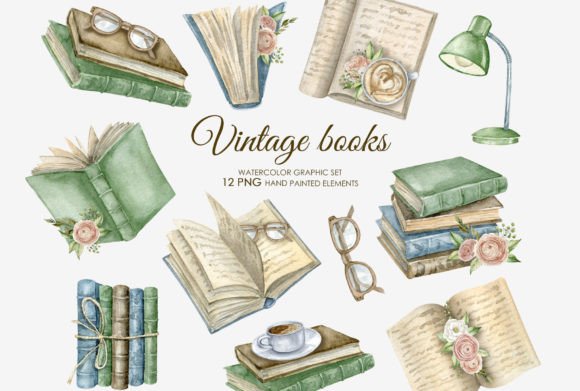
The specific collection featuring 12 high-quality PNG elements represents more than just a set of images; it is a toolkit for transforming flat digital spaces into rich, atmospheric environments. With a resolution of 300 DPI and transparent backgrounds, these assets are engineered for professional application, ensuring that whether they appear on a giant poster or a small social media icon, the integrity of the hand-painted strokes remains intact. Understanding how to leverage such resources effectively requires looking beyond simple insertion and considering the broader context of design aesthetics, technical specifications, and practical implementation strategies.
The Aesthetic Power of Hand-Painted Textures
The primary allure of Watercolor Vintage Books Clipart lies in its ability to bridge the gap between the digital and the physical. In a world dominated by sterile screens and pixel-perfect interfaces, the introduction of watercolor effects introduces a sense of warmth and humanity. The medium of watercolor is inherently unpredictable; pigments bleed into one another, creating soft edges and subtle gradients that are difficult to replicate with standard digital brushes without significant effort.
Vintage books, as a subject matter, carry their own weight of symbolism. They represent history, wisdom, and the tactile experience of turning pages. When combined with the fluidity of watercolor, these images evoke a romanticized version of the past—a time when objects were crafted with care and materials were natural. For designers, this combination offers a shortcut to establishing a specific mood. Whether the goal is to create a cozy atmosphere for a reading blog or a sophisticated backdrop for a literary event, these illustrations provide immediate contextual cues that resonate with audiences on an emotional level.
Furthermore, the "hand-painted" aspect adds a layer of authenticity. Unlike stock photography which can sometimes feel generic or overused, original illustrations offer a unique artistic signature. The variations in color saturation and the visible texture of the paper grain (even when digitized) contribute to a depth that flat colors cannot achieve. This depth is crucial for projects aiming to stand out in crowded digital feeds, where users are constantly scrolling past polished but soulless content.
Technical Specifications and Workflow Integration
While aesthetic appeal is paramount, the technical robustness of graphic assets determines their versatility. The set comprising 12 PNG elements is specifically optimized for both home and professional use, addressing common pain points faced by designers. The most critical specification here is the 300 DPI resolution. In the printing industry, 300 dots per inch is the standard benchmark for high-quality output. Assets with lower resolutions often appear pixelated or blurry when printed at larger sizes, rendering them useless for posters, packaging, or textile prints.
By providing files at 300 DPI, this collection ensures that the intricate details of the book spines and watercolor washes remain sharp even when scaled up. This makes the clipart suitable for large-format applications like banners or wall art, where detail loss would be immediately noticeable. Additionally, the RGB color mode is ideal for screen-based media, ensuring vibrant and accurate color representation on monitors, tablets, and smartphones. However, for print professionals, it is worth noting that while RGB is the starting point, conversion to CMYK may be necessary depending on the specific printing press requirements, though the high resolution usually mitigates significant color shifts.
Another vital feature is the transparent background. In modern graphic design workflows, flexibility is key. Designers rarely work with isolated images against white squares; instead, they layer elements over complex backgrounds, photographs, or other graphical components. Transparent PNGs allow the Watercolor Vintage Books Clipart to blend seamlessly into any composition. There is no need for tedious masking or background removal processes in software like Photoshop or Illustrator. This saves valuable time and allows creators to focus on composition and creativity rather than technical cleanup.
Diverse Applications Across Industries
The versatility of this 12-element set extends far beyond a single niche. Because the imagery is rooted in universal themes of literature and learning, it finds relevance in a wide array of sectors. Below are some of the most impactful ways these assets can be utilized:
- Scrapbooking and Paper Crafts: Enthusiasts who blend digital and physical crafting can print these images onto specialty paper. The vintage aesthetic complements aged papers, washi tapes, and journaling cards perfectly. The high resolution ensures that even when printed on smaller scrapbook pages, the textural details of the books remain clear.
- Textile Industry and Apparel: Fabric printing requires high-resolution artwork to prevent blurring on the final product. These illustrations can be repeated to create patterns for t-shirts, tote bags, or fabric swatches. The soft edges of the watercolor style translate beautifully onto cotton and linen, avoiding the harsh look often associated with screen-printed vectors.
- Packaging Design: For businesses selling stationery, candles, or artisanal goods, packaging is a critical touchpoint. Incorporating Watercolor Vintage Books Clipart into box designs or labels can instantly elevate the perceived value of a product. It suggests a brand that values tradition, quality, and intellectual curiosity.
- Web Design and Social Media: On the web, these images serve as excellent focal points for headers, blog post thumbnails, or social media stories. They break up blocks of text and add visual interest without overwhelming the user interface. Their transparency allows them to float elegantly over gradient backgrounds or photographic collages.
- Event Projects and Invitations: Book clubs, library fundraisers, academic conferences, and literary festivals all benefit from thematic visuals. Using these clipart elements for invitations, programs, and signage creates a cohesive visual identity that sets the tone for the event before a guest even arrives.
Strategic Implementation for Brand Identity
For business owners and marketers, the choice of imagery is never arbitrary; it is a strategic decision that influences brand perception. Utilizing Watercolor Vintage Books Clipart signals a specific brand personality: one that is thoughtful, curated, and perhaps slightly nostalgic. This is particularly effective for brands targeting educators, researchers, writers, and hobbyists who appreciate the finer details of life.
When integrating these elements into a marketing campaign, consistency is key. Rather than using the images sporadically, consider developing a visual system around them. For instance, a series of promotional posts could each feature a different book from the 12-element set, creating a narrative arc or a collection feel. This approach not only maximizes the utility of the asset pack but also keeps the audience engaged with fresh yet familiar visuals.
Moreover, these illustrations can be combined with typography to create powerful logos or wordmarks. The organic shapes of the watercolor books can frame text or sit alongside it to soften the rigidity of corporate fonts. This juxtaposition of structure (text) and fluidity (watercolor) creates a balanced and memorable logo that stands out in a sea of geometric minimalism.
Enhancing Educational and Research Materials
Educators and researchers often struggle to make dry or dense information visually engaging. Infographics, presentation slides, and educational worksheets can benefit immensely from the inclusion of relevant, high-quality imagery. A slide discussing the history of publishing or a worksheet about classic literature becomes significantly more inviting when adorned with Watercolor Vintage Books Clipart.
The visual cue of a vintage book helps learners connect abstract concepts to concrete representations. It serves as an anchor for memory, making the material more retainable. Furthermore, because the images are hand-painted, they avoid the copyright pitfalls often associated with using famous book covers or historical photographs, offering a safe and ethical alternative for public distribution.
Considerations for Long-Term Usage
While the advantages of using high-quality clipart are numerous, there are considerations to keep in mind for long-term project success. First, file management is crucial. Since the download includes 12 distinct elements, organizing them properly within a digital asset management system ensures they are easily retrievable for future projects. Naming conventions should reflect the content (e.g., "vintage-book-red-spine.png") to streamline the creative process.
Secondly, understanding the licensing terms is essential. While many such sets are available for commercial use, verifying the specific permissions regarding redistribution or modification is a best practice. Ensuring that the usage aligns with the license agreement protects both the creator and the user from potential legal issues.
Finally, while these images are versatile, they should be used with intention. Overcrowding a design with too many elements can lead to visual clutter, diluting the impact of the message. The strength of Watercolor Vintage Books Clipart lies in its subtlety and charm; allowing negative space around the illustrations often yields a more sophisticated result than filling every corner of the canvas.
Conclusion on Creative Potential
The intersection of traditional art techniques and modern digital formats continues to yield powerful tools for creators. This set of 12 PNG elements, characterized by their 300 DPI resolution, transparent backgrounds, and hand-painted quality, exemplifies this synergy. By incorporating Watercolor Vintage Books Clipart into their workflows, professionals and hobbyists alike can inject a sense of history, warmth, and artistic flair into their projects.
Whether the goal is to design a stunning poster, create a unique textile pattern, or simply enhance a social media presence, these illustrations offer a reliable foundation for visual storytelling. They remind us that in the digital age, the appreciation for the handmade and the vintage remains as strong as ever, providing endless opportunities for those willing to explore the depths of their creative potential.